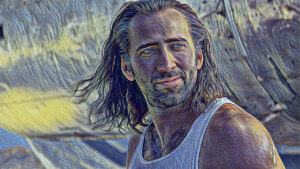
Nicolas Cage + Kim Jong Un Biopic? We’d Believe It
This is Nicolas Kim Coppola – or, as the rest of the world knows him, Nicolas Cage. And before anyone asks, no, he’s not related to Kim Jong Un. Although, given Cage’s career choices, would anyone really be shocked if he announced tomorrow that he was starring as the North Korean dictator in an experimental black-and-white arthouse biopic? At this point, we’d probably just roll our eyes and say, “Yeah, that tracks.”
Born on January 7, 1964, Cage didn’t so much enter the world as crash-land into it like a Tinsel Town cruise missile. His entire career appears to be guided by one simple, unshakable philosophy: “Why not?” He’s the undisputed king of, “Wait… HE was in THAT?” One minute he’s winning an Academy Award, the next he’s starring in action films that pay no regard to either logic or physics, and somewhere in between he’s making a film about a man searching for a truffle pig. (Yes, that’s a real film. No, I’m still not emotionally prepared to explain it.)
The Coppola Connection (Or Not)
Here’s something you may find mildly interesting: Nicolas Cage was born into Hollywood royalty. His uncle is Francis Ford Coppola, the legendary director behind The Godfather. Most people would happily take that surname all the way to the bank. Cage did the opposite. He ditched “Coppola,” borrowed “Cage” from Marvel’s Luke Cage, and decided to carve out his own spectacularly bizarre career. If your family already includes one of cinema’s greatest directors, the obvious response is apparently to become Nicolas Cage.
A Career That’s One Part Genius, One Part “What?”
His filmography resembles something like a Vegas Strip buffet: there’s a little bit of everything, and by the end you’re wondering whether any of it belongs on the same plate.
He started out with Fast Times at Ridgemont High, although Sean Penn’s stoner role stole most of the attention. Then came Valley Girl, Rumble Fish, and, eventually, Leaving Las Vegas (1995), which won him the Academy Award for Best Actor. Let’s pause here for a moment and appreciate that. We live in a world where Nicolas Cage has an Oscar. Somehow, that fact gets funnier with every passing year.
That’s the Cage experience. For every Adaptation., where he somehow plays two versions of himself brilliantly, there’s a Ghost Rider, where he spends two hours riding a flaming motorbike while looking completely convinced this is high Shakespearean drama. Cage has never understood that “less is more.”
The Action Hero Years
During the ‘90s, Nicolas Cage somehow became one of Hollywood’s biggest action stars. The Rock, Con Air, Face/Off – yes, the one where him and John Travolta literally swap faces because apparently nobody in the writers’ room ever asked, “Is this really a good idea?” His superpower wasn’t muscles or martial arts: it was delivering utterly ridiculous dialogue with complete conviction. Only Cage could say, “How in the name of Zeus’s butthole?!” without cracking up on camera.
Drama, Memes & Bees
But action hero wasn’t enough. Cage has never been content staying in one lane. Romantic fantasy? City of Angels. Psychological drama? Adaptation. Folk horror? The Wicker Man. The latter, of course, which gave the internet one of its greatest gifts: “NOT THE BEES!” At this point, that scene has probably been viewed more times in meme form than as part of the actual film.
And just when you think you’ve got him all figured out, he wanders off to voice Spider-Man Noir in Spider-Man: Into the Spider-Verse. Because if you’re Nicolas Cage, even your side quests end up making perfect sense… eventually. In a career built on impossible gambles, perhaps the strangest thing of all is that they somehow keep coming off.
The Meta Masterpiece
Fast-forward to today, and Nicolas Cage has reached a stage in his career where he’s perfectly happy collaborating… with himself. If you’ve never seen The Unbearable Weight of Massive Talent, in which Cage plays a wildly exaggerated version of Nicolas Cage, do yourself a favor and fix that immediately. It’s the most Nicolas Cage film Nicolas Cage could possibly make. He basically stares straight down the camera and says, “Yes, I’m completely unhinged. Enjoy.”
As though acting weren’t enough, he’s produced films too (Shadow of the Vampire), directed one (Sonny), and spent millions of dollars buying things no sane person would consider a wise investment – including a dinosaur skull and, at one point, a pyramid-shaped tomb. The man doesn’t collect possessions; he collects conversation starters. He has a star on the Hollywood Walk of Fame, yet somehow it still feels like he’s only getting warmed up. With recent films like Dream Scenario and Longlegs, Cage continues hurtling into increasingly bizarre territory. The question is no longer whether Nicolas Cage sleeps; it’s whether he simply rides a flaming motorcycle into the Hollywood sunset every night before waking up ready to out-Nicolas Cage himself all over again. You don’t just watch Nicolas Cage – you experience him. And honestly, who else could possibly play Nicolas Cage aside from Nicolas Cage?
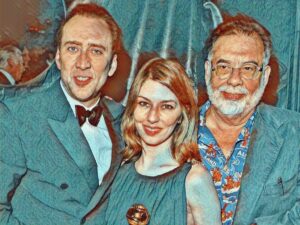
Nicolas Cage’s Family: From Coppola Roots to Cage Rage
Nicolas Cage’s story begins in Long Beach, California. His father, August Coppola, was a literature professor; his mother, Joy Vogelsang, was a dancer and choreographer. Between Shakespeare and stage lights, melodrama was practically written in his DNA.
Then there’s the insane family tree. On his father’s side, Cage inherited Italian roots – and one of Hollywood’s most intimidating surnames. His grandparents were composer Carmine Coppola and actress Italia Pennino. His great-grandparents came from Bernalda, a picturesque town in Basilicata that sounds less like a birthplace and more like the setting for a Christmas film that’s steeped in pots of boiling pasta and ancient family secrets. On his mother’s side there was German, Polish, English and Scottish ancestry, making Cage less a melting pot than the European Union with a side parting.
And then there was the small matter of Hollywood royalty. Francis Ford Coppola is his uncle. Talia Shire is his aunt. Sofia Coppola and Roman Coppola are his cousins. Throw in Gian-Carlo Coppola, Robert Schwartzman and Jason Schwartzman, and Christmas dinner starts looking less like a family gathering than the closing credits of an Oscar-winning picture.
Most people would have happily coasted on the Coppola name. Cage wanted no part of it. Instead, he ditched the family surname, borrowed “Cage” from Marvel’s Luke Cage (with a nod to avant-garde composer John Cage), and set out to succeed on his own terms. It was either a bold career move or the world’s most elaborate attempt to dodge accusations of nepotism.
He grew up with two brothers: Marc, a radio DJ, and Christopher, a filmmaker, proving that in the Coppola household, entering the film industry was treated less as a career choice than a birthright. Cage attended Beverly Hills High School, which was basically a Hogwarts for future stars of the screen, where a school production of Golden Boy convinced him acting was his destiny. Around the same time, he became obsessed with James Dean. Not casually obsessed in the typical teenage way – more an obsession where a fifteen-year-old convinces himself he’ll actually come to embody the affection of his desires.
Which perhaps explains his next move. At fifteen, he marched up to his uncle, Francis Ford Coppola, and simply demanded, “Give me a screen test. I’ll show you what real acting looks like.” His uncle politely declined. It must have been one of the most awkward family car journeys in Hollywood history.
Yes, Cage appeared in a few Coppola productions early on, but he was determined not to spend his career as “Francis Ford Coppola’s nephew.” So Nicolas Coppola became Nicolas Cage – a name now famous enough that many people don’t even realize it was ever changed. That’s the Cage paradox: born into one of cinema’s greatest dynasties, yet somehow becoming something even stranger. He didn’t escape the family legacy by rejecting Hollywood. He escaped it by becoming the only person on Earth who could convincingly be… Nicolas Cage.
Nicolas Cage Films (1981–1988): Chaos, Charisma & Pure Genius
Nicolas Cage’s body of work as an actor is a theme park designed by a lunatic with a PhD in “what could possibly go wrong?” One moment, it’s high-flying, Academy-worthy material, and the next it’s upside-down twists and spinning corkscrews of so-wrong-it’s-right decisions that leave you yelling, “What am I watching?!” And still, somebody enjoyed it. The uncertainty, the whiplash – that’s Nicolas Cage’s magic. He doesn’t act; he infuses madness into life. Let there be flops – we come to roast, toast, and question his career moves because nobody does “Full Cage” better than Nicolas Cage does.
The Eccentric Punk Romeo (1983)
Seeing it: Valley Girl, a bargain-rate Romeo and Juliet set aflame with neon-infused ’80s colours and filmed through a bottle-white fog of Aqua Net. The actor himself portrays Randy, a punk-rock legend with a penchant for mixtapes and a combustibility that screams, “I may or may not erupt into tears at a moment’s notice.” He falls hard for Julie, a valley girl packed to the brim with legwarmers and mall culture. It’s schmaltzy, it’s sentimental, but it’s undeniably Cage.
Until now, however, you could never quite tell whether his lovesick hound-dog eyes were deep and soulful or whether he simply needed to go to the toilet. Nevertheless, the guy courted his love interest with a Clash mixtape, punk-rocking Shakespeare into the next century. Tragic missteps? Love? Horrendous synthesizers? Valley Girl was our first proper taste of proper Nic Cage seasoning – and, naturally, we became addicted.
Oscar, Is That You? (1987)
Then came Moonstruck, a rom-com no less messy and lovely than your Italian grandma’s Sunday lunch. Cage stars opposite Cher as Ronny, a one-handed baker who is bitterly furious at “life and love and bread, it seems.”
What other actor could sell a monologue in which a disheveled, smoke-wreathed baker unleashes his existential despair on a woman in his bakery? Cage, naturally. It’s demented melodrama played with such absolute sincerity that you find yourself wondering whether life really would be better with fewer carbs. Critics praised it; we were flabbergasted. He even earned a Golden Globe nomination, proving once and for all that dramatic collapse, when properly seasoned with bread, can indeed become art.
When the Coen Brothers Got into Trouble (1987)
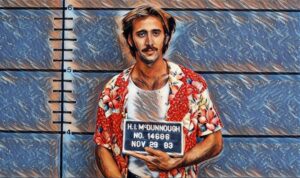
If you’ve never seen Raising Arizona, then rectify that. Right now. This very minute. Like, yesterday. Cage portrays H.I. McDunnough, a genuinely unstable ex-con who believes snatching a baby is a darn acceptable cure-all for his marital ills. Logical? Never. Hilarious? Umm, yes.
It’s a playground where one man moves from slapstick to lovesick goofiness with such ease. He’s scuttling around the desert in stolen pantyhose, carrying a stolen baby. It should’ve been insanity, but instead becomes sheer genius. That’s just Cage being Cage – concocting completely ludicrous situations that are somehow strangely touching. There’s probably a real baby in the audience ready to give him a standing ovation when he grows up.
The ”Mad Dog” That Everyone Never Forgot (1984)
Oh, The Cotton Club. It’s a story of gangsters and jazz that flopped like a drunk at closing time. But Cage? He didn’t stagger, not at all. It was his round.. He exploded onto the screen as wild-eyed Vincent “Mad Dog” Coll, a man madder than a trout in a carwash.
Yes, it wasn’t a blockbuster, but Cage’s “go big or go completely berserk” manifesto made every frame he appeared in unforgettable. His Mad Dog was a masterclass in snarling, crazed madness – as though he’d mistakenly wandered into a gangster film before declaring, “We’re improvising, and we’re doing it loud!” Critics noticed, proving Cage could act up a storm even while the box office went up in flames.
The Metaphorical Lightning Rod (1984–1986)
Between Birdy and Peggy Sue Got Married, Cage was cementing himself as Hollywood’s king of “Wait, what’s he doing now?” He played a tormented soldier… and then a man obsessed with birds (parrots, naturally, because, hey, no reason to question things in Cage’s universe).
Thought he was committed? He notoriously had his teeth pulled for authenticity. His actual teeth. Not veneers, no CGI, no nothing. And suddenly everyone else looked a little too middle-of-the-road by comparison.
America’s Loose Cannon
Not all Nicolas Cage movies are home runs. Some are third-draft hallucinations. But when Nicolas Cage lands, oh boy, does he land. This is a man who’s been a punk-rock Romeo, a baby-stealing ex-con, a one-armed baker, and a flat-out mad dog. You don’t watch Nicolas Cage; you endure Nicolas Cage. You walk away from his movies with no idea whether to cheer or seek immediate therapy. And isn’t that, folks, what movies are supposed to be all about?
Cage is no ordinary actor. He’s living, breathing performance art. He’s disruption and charisma embodied in one strange work of art. And, inexplicably, maybe that’s the greatest representation of life.
Inside Nicolas Cage’s Most Bizarre Career Years (1989–1994)
Bizarrely Incoherent Odyssey Through Nicolas Cage’s Experimental (but Eccentric) Career
What do camp vampires, Elvis impersonations, and bargain-bin Top Gun rip-offs have in common? And no, this isn’t a joke. The answer? Nic Cage’s creative output between 1989 and 1994. It was a period of experimentation during which, legend has it, Cage said yes to every single script that crossed his desk, however preposterous, dangerous, or frankly jaw-dropping it may have been.
It was the Bermuda Triangle of screenwriting, where reason and moderation vanished completely into thin air. Yet, by alchemy or accident, something wonderful emerged from all that madness. He became a legend. A meme-worthy, unbelievable, oft-critiqued legend. Buckle up, everyone – we’re about to take a wild tour through Cage’s crazy career.
1989: Enter the Vampire
First, Vampire’s Kiss (1989). This black comedy noir, in which a man believes he’s becoming a vampire, deserves an internet corner of its own. Cage, who shows up with plastic vampire fangs and manic enthusiasm enough to light up a small city, gives a performance that veers from sublimely ridiculous to “What did I just see?” Critics shredded it (“Self-indulgent, overly theatrical mess,” snarked The New York Times’ Vincent Canby). Fans boycotted. Still, it endures to this day as a cult film, forever solidified within meme culture. If you’ve seen that bug-eyed gif of Cage, congratulations—you’ve seen cinematic history.
1990s Kickoff with Elvis and Helicopters
Skip to Wild at Heart (1990), David Lynch’s bizarre collision of crime, romance, and Elvis impersonation. Sailor Ripley, played by Nicolas Cage, is a man fanatical about his snakeskin leather jacket (individuality and personal freedom, of course) and crooning Elvis songs to his love, played by Laura Dern. Split reactions? You bet. But the film walked away with the Palme d’Or at Cannes. Only Lynch could make loose love birds and hitmen feel like, well, nearly poetry.
Still not quite finished with Lynch, Cage added his lyrics to Industrial Symphony No. 1, a bizarre collaboration involving ghostly floating girls and… no further explanation. Frankly, it’s probably easier to decipher hieroglyphics.
Then there was Fire Birds (1990), desperately wishing to be Top Gun: Army helicopter edition, but ending up the film equivalent of making Ray-Bans from glasses purchased at the pharmacy. Critics thrashed it. Cage played a hotshot flyboy facing nasty enemies and some truly sideways Hamlet-style dialogue.
Straight to the VHS Bargain Bin
1991’s erotic thriller Zandalee missed theatres entirely, going direct-to-VHS with a swagger it arguably didn’t deserve. Heavy on sweaty close-ups, melodrama, and Cage’s eccentric gaze toward almost everything, it failed to ignite much excitement. But it remains worth a popcorn-munching watch just to see Cage’s half-charming, half-crazed mojo.
1992–1993: Elvis Meets Cringe Dad
Then came Honeymoon in Vegas (1992), a romantic comedy where Cage sported an Elvis-like jumpsuit and parachuted into matrimony. Roger Ebert found Cage’s excesses over-the-top yet endearing, while others were less convinced. During promotion, a Saturday Night Live sketch hosted by Cage showed he could blend Elvis theatrics with klutzy-dad sensibility and a genuine sense of humour.
But 1993 was far less forgiving. Red Rock West, Deadfall, and Amos & Andrew all arrived at once and quickly disappeared. The former, directed by brother Christopher Coppola, proved that nepotism does not guarantee quality cinema. Expect deranged sneers, chaotic plot twists, and Cage simmering like a supernova even as the script struggles to stay afloat.
Wholesome… then WH
He sought to redeem himself with It Could Happen to You (1994), playing a gentle-hearted cop who splits his lottery fortune with a waitress. Sweet? Yes. Forgettable? Also yes. Then came Trapped in Paradise (1994), which trapped Cage in one of the worst-reviewed comedies of the decade. Descending into chaos as SNL comedians Jon Lovitz and Dana Carvey improvised their way around the film, it’s no surprise Cage reportedly intervened to direct parts himself. Comedy? Hostage situation? We may never know.
Bold Steps, Nutty Legacy
Nicolas’s 1989–1994 experimental years were a collection of “choices.” Gold, trash, or both? The question never mattered. The truth is, every character, however flaky, arrived with undying energy from a man armed with snakeskin coats, plastic vampire dentures, and enough Elvis impersonation to make a Vegas act jealous. Regrettable? No. Audacious? Absolutely. Legendary? Yes. And wasn’t that exactly what we loved about Nic Cage?
Nic Cage Unleashed (1995–2003): Chaos, Oscars, and Cult Classics
If you’ve ever watched Nicolas Cage act and thought, “Is he acting or putting together a solo performance art exhibit?”—no judgement, you’re among friends. Buckle up—we’re returning to his wackiest, meme-iest, and Academy Award-winning work from 1995 to 2003. Spoiler alert: critics were sometimes left wondering exactly what they had just witnessed.
1995: The Year Twice Cage Stole the Show
It’s 1995. Cage begins with Kiss of Death, where he plays a gangster boss with the subtlety of a sledgehammer. Critics called him the “strongest point” of the film—a fancy way of saying he stole it completely. David Caruso, the supposed lead, could still be protesting.
But Cage wasn’t finished. Months later, Leaving Las Vegas arrived, and Cage effectively said, “Hold my whiskey!” To play an alcoholic screenwriter destroying himself with booze, he binge-drank for two weeks to prepare. Method acting or an excuse for a binge? You decide. Either way, it paid off: an Academy Award, a Golden Globe, and what was presumably a worldwide standing ovation from bartenders. Iconic. Unhinged. Pure Cage.
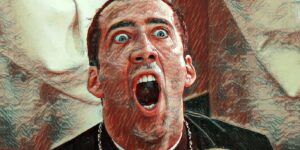
1996–1997 Action Hero Period: The Rock, Con Air, and Face Swapping
By 1996, Cage decided the world needed him as an action hero. Enter The Rock, where he transformed from Academy Award-winning sad boy into a cerebral FBI chemical expert teaming up with Sean Connery to steal back Alcatraz. Possible? Not remotely. Enjoyable? 100%.
Then came 1997. Oh, 1997. He headlined Con Air, playing Cameron Poe, a long-haired Southern convict trapped on a plane full of lunatics. Roger Ebert called it “the wrong choice.” Show that to the cast and crew. Right or wrong, it became a cult classic among gloriously ridiculous movies.
But wait, there’s more. That same year brought Face/Off, where Cage and Travolta exchanged faces and competed to see who could push acting insanity further. Critics loved it. Fans loved it. Science? Absolutely not. Watching Nic Cage as Travolta and Travolta as Nic Cage remains worth every absurd second.
1998–1999 Drama Detour (With Some Angels)
Cage, apparently tired of explosions, took a detour into melodrama. There was City of Angels (1998), where he played an angel who falls for Meg Ryan. Critics were divided: some praised his “endlessly resourceful” performance, while others compared his presence to “a serial killer in celestial drag.” Ouch.
Then came Snake Eyes, a corrupt-cop-at-a-boxing-match thriller filled with excessive zooms, wind-blown monologues, and a screenplay critics seemed to think was written during a whiskey binge.
Fortunately, 1999 corrected course with Bringing Out the Dead, where Cage was neurotic and aggressively present as a burned-out paramedic in a Scorsese-directed film. Box office? Eh. Performance? Just unsettling enough – a reminder that nobody descends into madness quite like Cage.

2000-2003 Reinvention, Conmen, and Twins
The 2000s combined action with melodrama. First came Gone in 60 Seconds, where Cage played a full-blown adrenaline junkie and former car thief. Story-wise, it was an eye-roller, but its financial success proved Cage could blow things up and still bring in a crowd.
Then came Adaptation (2002), a brain-spinner where Cage played, no joke, twins: a neurotic screenwriter and his jovial brother. Critics rushed to praise his genius, and it earned another Academy Award nomination. The same year also saw him direct Sonny, a film everyone diplomatically agreed never to mention again. In between came 2003’s Matchstick Men, a sharp heist film where Cage’s obsessive-compulsive conman once again proved he could carry films beyond expectations.
Grand Finale? In Fact, Just Intermission
By 2003, Cage was Hollywood’s walking paradox. He could be both a commercial wild card and a darling of the critics. Whether body-swapping with Travolta, binge-drinking his way to Oscars, or playing corrupt car thieves and angels, he did something more than simply act. Cage burst through scripts and delivered performances so fantastically deranged they could never be forgotten.
Love him, meme him, or watch from a distance, one thing is certain with Nicolas Cage: acting is never about safety. It is all about danger. And nobody embraces danger quite like Nicolas Cage. Cheers to you, Nic. We could all so with being a little more adventurous (and eccentrically compelling at the same time).
Nicolas Cage 2004–2011: The Treasure Hunter & Flaming Skull Era
Nicolas Cage’s film history during this bizarre period was a roller coaster of loops, switchbacks, and occasional flaming wreckage. Fasten your seatbelts as we look back on the highlights (and, ahem, misfires) of his career. Spoiler alert: there’s plenty of yelling, countless questionable decisions, and, yes, bees – lots and lots of bees.
1995–2003: Action Hero to Academy Winner to Franchise King
It was in the mid-’90s that Cage broke into megastardom with a mix of grime, action, and… Con Air. With 1995’s Leaving Las Vegas, he won his Academy Award and proved that beneath all the madness was a genuinely gifted actor. But because Cage never chooses the predictable route, he followed Oscar success with over-the-top action epics like 1996’s The Rock, 1997’s Con Air, and 1997’s Face/Off – all of them so utterly ridiculous they became instant classics.
During this period, Nic’s career was essentially a slow-motion action sequence, a melodramatic stare, and Cage announcing his intention to steal the Declaration of Independence. Which, by coincidence, leads to…
National Treasure, 2004
Well, National Treasure. Indy’s action-adventure history-major treasure-hunter successor arrived in the form of Ben Gates, played by Cage. Maps? Secret societies? Ridiculous leaps of logic? This film shouldn’t have worked. And yet, it became a financial success, cementing its place as Cage’s second-biggest film. We laughed. We smiled. We learned that sometimes true treasure really isn’t the friends we’ve made along the way but massive piles of cash instead.
2005–2006: The “Hey, At Least I’m Acting” Era
Before 2005, Cage experimented with Lord of War and The Weather Man, with both receiving mixed reviews but generally considered “good, if forgettable.” Then came 2006’s The Wicker Man, which achieved worldwide meme status thanks to the unforgettable shout, “NOT THE BEES!” line. It was a remake nobody asked for – and no one needed – with its lasting legacy now a host of YouTube parody videos rather than genuine rewatchability.
2007–2008: Ghost Riders and Werewolves and Bangkok, Oh My
Ghost Rider (2007) deserves a slow clap: stupid, proud, and strangely fun. The flaming-skulled antihero was everything ridiculous Hollywood could dream up and then some. Critics hated it, but audiences showed up in their droves.
Then came 2008’s Bangkok Dangerous, where Cage played a guilt-ridden hitman in Thailand. Stylish enough, perhaps, but its box-office returns were lousy for the time and money invested.
There was also his brief appearance in 2007’s Grindhouse as Fu Manchu in the fake trailer Werewolf Women of the S.S. Five minutes of Cage, 100 minutes lost.
2009–2011: The Cage Renaissance (Sort Of)
Knowing (2009) is what happens when you combine an end-of-the-world screenplay with Cage as an MIT professor mapping out disaster scenarios. Critics weren’t impressed, but audiences embraced its mix of chaos and existential terror.
The real star, however, remains Bad Lieutenant: Port of Call New Orleans. Werner Herzog’s direction and Cage’s loose, unpredictable performance created a fever dream of corruption, drugs, and hallucinating iguanas. Insane? Absolutely. Brilliant? 100%.
His turbulent later years swung back toward the unbelievable with The Sorcerer’s Apprentice (2010) and Season of the Witch (2011). Fantastical nonsense, excessive CGI, medieval confusion, and Cage stumbling into questionable choices once again. And naturally, to finish things off, there was the totally unnecessary and completely inexplicable Ghost Rider: Spirit of Vengeance.
From blockbuster hits to meme-worthy failures, Nicolas Cage remains Hollywood’s wildest leading man. He throws himself into every role with life-or-death intensity. His career is built on brilliance, bombast, and complete madness – and we wouldn’t have it any other way. From box-office smash to cult disaster, Cage is more than a star. He’s a phenomenon.
The Cage Age of Madness: Most Chaotic Career Moments
Nicolas Cage in Stolen and More Bizarre Movie Swings
Nicolas Cage. The man, the myth, the meme. Few actors have cultivated a career as eccentrically unpredictable (and, ahem, unhinged) as Cage. A ticket to a Nicolas Cage movie is less an ordinary moviegoing experience and more a front-row seat to one of Hollywood’s strangest human experiments. From 2012 to 2017, Cage delivered performances ranging from laughably entertaining to “why does this even exist?” Buckle up as we revisit his biggest career swings during his golden age of madness.
You know Stolen? If so, it’s not a problem – so does the entire world. Cage played a reformed thief given a limited window to rescue his kidnapped daughter. It’s like a straight-to-VHS version of Taken you’d find in your local thrift store. The silver lining? Cage brooded, dashed, and scowled his way through it. The bad news? Audiences and critics simply couldn’t stand it.
Nicolas Cage’s 2013 Hat Trick of Chaos and Genius
Now let’s take a look at 2013: the year Cage netted a hat-trick of prehistoric family chaos, serial-killer drama, and indie film grit.
First came The Croods, with Cage voicing Grug, a prehistoric patriarch whose priorities are protecting his family and raging like a man who just stepped barefoot on Lego. Critics loved it. The box office? A mighty $585 million for a film about caves, rocks, and family values. Even cavemen adore Cage.
Then came The Frozen Ground. Cage versus John Cusack. It’s cold. There are serial killers. A near-fatal teenage encounter survives thanks to Vanessa Hudgens. Check, check, check, check. The film itself was a mixed bag, but Cage’s grumpy Alaskan state trooper was eerily compelling. Calling it a “family Friday night” movie would be a stretch – unless you belong to a particularly cruel and violent one.

Leaving Las Vegas to Cannes Chaos: Cage Unleashed
Third came Joe. That’s where audiences raised an eyebrow and said, “Oh, look, he’s acting!” With a grizzled appearance and a surprisingly soft centre, Cage once again showed why he remains Hollywood’s great mystery man. Bringing echoes of his Leaving Las Vegas brilliance, he gave critics plenty to get their teeth into.And the box office? Let’s just say it probably paid for the popcorn. Critical acclaim? Absolutely. Indie credibility? Locked and loaded.
Skip ahead to 2016 and Dog Eat Dog, a crime-comedy fever dream nobody could have predicted. Imagine Nicolas Cage and Willem Dafoe unleashed, diving into actual, literal kid-napping, chaos, and absolute anarchy. This wasn’t just a performance; it was Cage and Dafoe creating a manic chemistry powerful enough to overwhelm any theater.
Directed by Paul Schrader, the film premiered at Cannes – because who better to unleash a tidal wave of madness than on an audience of extremely serious film critics? Reviews ranged from “weirdly brilliant” to a general “what exactly did we just watch?” But isn’t that exactly what great art – and especially the art of Nicolas Cage – is supposed to do?
Mom and Dad: A Cage Rage Masterpiece, John Waters Approved
2017-ish, but Really 2018: John Waters’ Favorite
Then there’s Mom and Dad, a film where Nicolas Cage and Selma Blair’s “parenting” is cranked up to eleven. The story? Moms and dads suddenly develop an urge to murder their children through some absurd, nerve-twitching fit. Cage goes from 0 to 100 in less than a minute and stays there for what seems like forever, during a wild-eyed scene so OTT it becomes performance art.
It premiered during TIFF’s Midnight Madness, and rightly so, since there was only one place a film this rowdy could belong. Rotten Tomatoes gave Cage a virtual pat on the back, and John Waters declared it one of 2018’s finest. If John Waters gives his stamp of approval, then that’s all the validation required.
In Chaos, Nicolas Cage
From caveman dads to huntsman murderers to yanking babies from their prams, Nicolas Cage didn’t just act from 2012 to 2017; he moonwalked from extreme to extreme across the film spectrum. Even when the movies crashed and burned, Cage remained unpredictable, unrepentant, and completely captivating.
Isn’t that exactly what we’re here to see? He’s Hollywood’s wild card, his very existence a guarantee that no project he joins will receive anything less than 110% pure Nicolas Cage energy. And honestly, that alone deserves a standing ovation every single time.
Truffles, Talent & Technicolor Screaming: Since 2018
There’s only one man in Hollywood who can go from truffle hunting to playing Dracula and somehow make it seem like a well thought out career choice – and that man is Nicolas Cage.
Yes, Nicolas Kim Coppola himself: Hollywood’s great enigma, capable of swerving between high art, meme-baiting madness, and everything in between. Cage doesn’t appear in films; he consumes them whole, chews them up with his “feral intensity,” and leaves us mere mortals with Oscar-worthy crumbs as an afterthought.
Mandy (2018): Peak Cage, Peak Chaos
Remember Cage’s psychedelic fever dream Mandy? It premiered at Sundance, with critics such as RogerEbert.com’s Nick Allen praising Cage for reaching “career-best” levels of insanity.
The man wielded a chainsaw the length of your grocery list with such ferocity you’d think it had personally mocked his hairline. Producer Elijah Wood even campaigned for an Oscar nomination, but an early video-on-demand release technicality killed that dream stone dead.
Still, if they handed out awards for “Best Actor Channeling a Grizzly Bear on a Bad Day,” Cage would have been a two-time winner that year alone.
2018–2020: Cage Gets Animated, Noir & Lovecraftian
And who can forget Spider-Man Noir? Imagine Cage doing his best Humphrey Bogart impression in Into the Spider-Verse. It’s like someone said, “Hey Nic, you know those old black-and-white movies? Great. Be all of them at once.” Yet somehow, it worked.
Before that, he went meta with Teen Titans Go!, voicing Superman – a role he once nearly played in real life in Tim Burton’s ill-fated Superman Lives. See? Even Cage’s failures have multiple layers of depth.
Then came 2020’s Color Out of Space, a Lovecraftian acid trip featuring alpacas, demented, screaming chaos, and Nicolas Cage battling a technicolor alien invasion. It’s as though Cage said, “What’s missing from this genre is MORE Cage,” and somehow made it terrifyingly brilliant.
Naturally, this level of insanity earned him awards – for simply being his strange, unhinged self.
Wife #1: Patricia Arquette

First on Nic’s matrimonial rollercoaster was Patricia Arquette. They married in 1995, and for six whole years, things were (relatively) ordinary – for Cage, at least. There isn’t much to report here, which, quite honestly, is suspicious from a man whose life is otherwise chaos in IMAX.
Wife #2 Is Literally Royalty
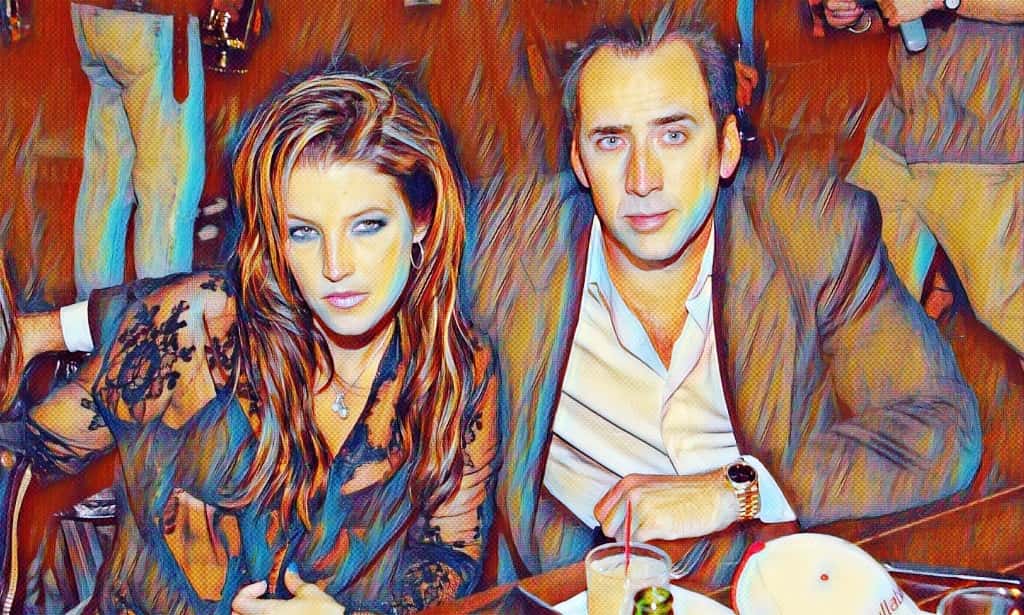
And then there’s Lisa Marie Presley. That Lisa Marie Presley. Elvis’s daughter. And if you know anything about Nicolas Cage, you’re saying to yourself, “Of course he’d marry Elvis’s daughter.” The lead in Wild at Heart more or less worships Elvis, even channeling The King in his performance.
Their love story? A whirlwind by any standard. Nic and Lisa Marie married in Hawaii in 2002, and a whopping 107 days later, they hit Ctrl-Z on the whole ordeal and divorced. That’s barely the length of a Netflix mini-series. It took two years to fully finalize the breakup because life, apparently, is more bizarre than fiction when Nicolas Cage is involved.
Wife #3 Accomplished the Impossible

Nic’s subsequent record-breaking romance was with Alice Kim. They married in 2004 in an adorable ranch wedding and welcomed a son, Kal-El, in 2005. (Yes, Kal-El, as in Superman’s Kryptonian name. Was there really any other option for a Nic Cage kid?)
Alice lasted for twelve years, which, in Cage years, is practically forever. That’s longer than most Marvel franchises. Sadly, the “happily-ever-after” ended in 2016. Still, twelve years and a Superman-worthy kid? Not bad.
Wife #4 Was Pretty Much a Blink

Now we come to Erika Koike, a union so speedy it had the shelf life of cheap milk. They tied the knot in Las Vegas (classic Nic) in 2019, but just four days later, Cage concluded he might have been “too drunk to comprehend his actions.” So, a perfectly normal Vegas wedding, in other words.
It only got messier when Erika’s “complicated personal life” came to light, and Nic requested an annulment faster than the rest of us cancel free trials. The divorce was finalized in just three months, making this one of Hollywood’s fastest finales.
Wife #5 and a New Horizon

And here we are today with wife #5, Riko Shibata. Nic married Riko on February 16, 2021, making it official while the Valentine’s Day vibes were still in the air. Just when it seemed like Cage would catch his breath, Riko gave birth to their daughter, August, in 2022.
It’s the perfect punctuation mark in this wild, unpredictable, strangely endearing family story. At 59, Cage has moved from black metal concerts and Superman-inspired baby names to quiet domestic life with wife #5 and his youngest son.
Hollywood Script or Nicolas Cage Biography?
Nicolas Cage doesn’t so much live life as write it in real time, complete with all the ridiculousness, drama, and heart you’d expect from a guy who once bought a dinosaur skull simply because, why not?
From extreme metal gigs to Elvis connections to marriages that don’t last longer than a carton of eggs, Cage’s love life is pure, unscripted entertainment. And honestly? We wouldn’t have it any other way.
Nicolas Cage’s Strange World of Philosophy, Politics, and the Quest for the Holy Grails
Nicolas Cage is not only an actor but an experience. You don’t just view his films; you experience them. You’ve also been pushed over the edge of reason through his enthusiasm for building castles as a hobby, sat on the edge of the couch during his overbearing performances, and perhaps questioned how his barber created that hairline..
But do we even understand the depths of his off-screen feeling about politics or religion being as absurd as his on-screen career? Hold onto your seats. This ride has more twists and turns than National Treasure and roughly as few questions actually answered.
A Sacred Cup, But Not on the House
Nic Cage’s spiritual routine is characteristically Cage. As a Catholic, perhaps we should expect answers about religion filled with ecumenical wisdom, a sprinkling of Thanksgiving, or some wry quip about humility.
Not so with Mr. Cage.
“Looks best on the screen,” Cage once said about people and movies. That is to say, religion remains unclear, and Mr. Cage seems to prefer it being as confounding as the plot of Face/Off.
But wait, it gets better. One time our beloved Nic actually attempted his Indiana Jones routine and hunted for the Holy Grail. Yes, *the* Holy Grail.
You’re searching through down the back of the sofa looking for your car keys while Cage is out there scouring the UK for a piece of medieval history. The UK was only the beginning of his modern-day Arthurian quest. He was also said to have searched parts of the United States. Because where else would a 12th-century Grail be except possibly Kansas?
Spoiler warning: the mission didn’t go well. But maybe it did. If Cage actually discovered immortal wisdom in a cup, the next time we’d hear about it would probably be during some totally unrelated interview where he’d be discussing his tax liabilities.
Politics, But Do It Sneakily
From spiritual cups to public policy gospel. Discussing politics with Nicolas Cage is like asking a cat to explain the finer points of string theory.
The guy is slippery.
Speaking on the University of California Santa Cruz campus, when someone brought up politics, Cage replied, “I’m not a politically active actor – I do it in my work.”
You know, like foaming at the mouth in The Wicker Man is political activity. Heavy-handed allegory or Nicolas Cage simply being all about the bees? A question we’ll never know the answer to (which, knowing Cage, is probably a good thing).
All rules have an exception, even Cage’s rules. Enter libertarian Andrew Yang’s 2020 presidential campaign. In the blink of an eye, Cage became an unlikely supporter of the then-candidate.
The guy who stole the Declaration of Independence found Yang to be the greatest treasure. Surprising? Yes. Does anyone know why? Of course not. But somehow their energies seemed to match. Sometimes life is about vibes.
Nicolas Cage’s Philosophy of Life
If Cage’s pranks and non-conformity have anything to teach us, it’s this credo (most likely inscribed in flickering letters on the back of a dinosaur skull sitting on his mantlepiece):
“Life is an adventure best enjoyed loudly.”
He doesn’t think outside the box – he blows the box up and writes his own myth in the ashes. Ask restrictive questions like “What do you think about politics?” and he’ll leap over them with the same passion he brought to piloting Con Air.
Here’s the catch, however: someone has to appreciate all thischutzpah.
Cage’s life isn’t about answers; it’s about questions. He may not have found the Holy Grail, but his life is a pursuit of something substantial – whether or not a mythical goblet inexplicably happens to be discovered in the wilds of Nebraska.
Channel Your Inner Cage
Nicolas Cage has given us ridiculous movies, even crazier haircuts, and belly-laugh scream after belly-laugh scream.
But his most transparent shame? The audacity to live shamelessly.
Whether it’s purchasing castles, supporting Yang, or going on literal treasure hunts, Cage challenges us all to laugh in the face of absurdity and commit fully to the experience.
Maybe your own Holy Grail is waiting somewhere. Maybe it’s a new job, calling a friend from the past, or simply getting the unnecessary second dessert tonight.
Who knows? If Nicolas Cage can scour the world chasing mythical icons, the least we can do is show up for the twists and turns of our own life stories.